SMB owners keep sharing the same screenshot. Page-one rankings holding. Impressions flat or rising. Organic sessions down 20 to 40%.
The dashboard reads that as a ranking problem.
It is a click-through problem.
Rankings measure whether Google will show you. They stopped measuring whether anyone leaves the results page to reach you.
Treating those as a single number and you’re optimizing a report that no longer describes how people exit Google.
The data: five studies on the CTR collapse
Zero-click search was already the default before any of this. SparkToro and Datos found that 58.5% of US Google searches end without a click to any external website.
AI Overviews made the leftover real estate optional.
| Study | Published | Sample | Finding |
| SparkToro / Datos | 2024 | US Google search panel | 58.5% of searches end with no click to an external site |
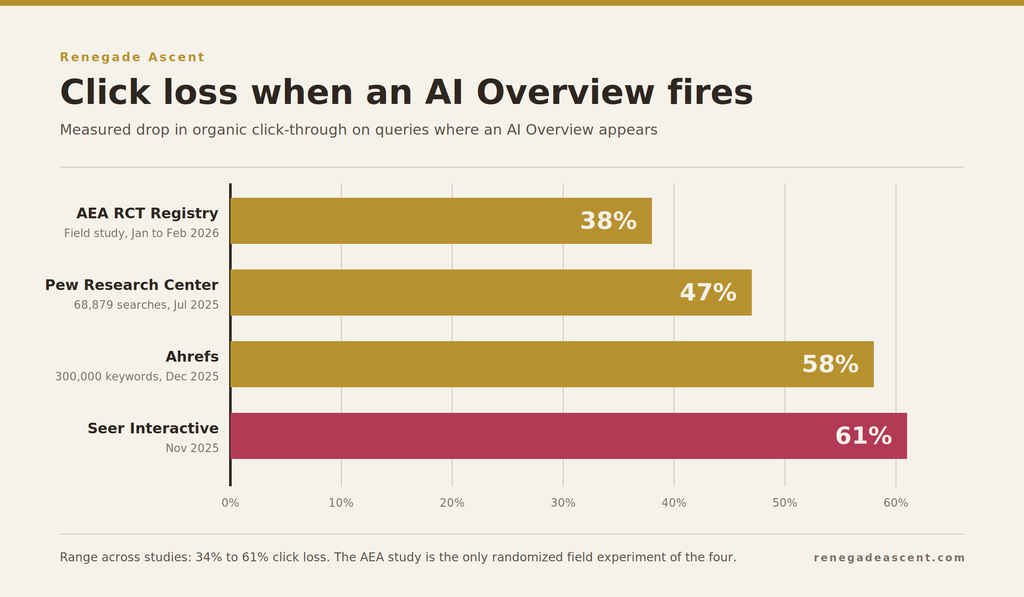
| Pew Research Center | July 2025 | 68,879 searches | Traditional result clicked 8% of the time with an AI Overview present vs 15% without, a 47% relative drop. 1% clicked a source link inside the Overview. |
| Seer Interactive | November 2025 | Overview-triggering queries | Organic CTR fell 61%, from 1.76% to 0.61%. Cited brands earned 35% more organic clicks and 91% more paid clicks. |
| Ahrefs | December 2025 | 300,000 keywords | Position-1 organic CTR dropped 58% when an Overview sat above the listing. |
| AEA RCT Registry field study | January to February 2026 | Randomized field experiment | AI Overviews cut outbound organic clicks 38% on triggered queries. Removing the Overview nearly doubled clicks. When triggered, Overviews held the top of the page 85% of the time. |
Put them on one table and the range holds: 34% to 61% click loss whenever an Overview fires.
That is not a core-update penalty. It’s a smaller slice of a page that already answered the query before your title tag got a chance.
The AEA study is the one that matters most, because it’s the only one isolating cause from correlation. Every other number here is an observed association. That one removed the Overview and watched the clicks come back.
What is actually taking the click
The 2026 results page is ads, an Overview, a map pack, a video carousel, and People Also Ask. Then your blue link.
When an Overview triggers it takes the first screen 85% of the time. The other modules finish the squeeze.
Organic listings drop below the fold on exactly the informational queries that used to feed a blog.
“What is,” “how to,” and comparison searches lose first, because Google can close the tab on the user’s behalf. Transactional and local queries leak fewer clicks, since someone still has to pick a vendor. Even those now share the fold with an answer box.
Zero-click search is just the user getting the answer and leaving. A perfect ranking still produces a session of zero.
How to diagnose whether this is your problem
Skip the new content calendar until Search Console says you earned one.
Pull impressions, clicks, and average CTR for the last six months.
The Overview signature is stable or rising impressions with falling clicks and falling CTR. That pattern is SERP crowding.
Impressions falling alongside the clicks is a different file entirely: a core update, a technical error, or lost rankings. Fix that before anything else.
Then work the list:
- Search the keywords that used to convert and screenshot the page. Note whether an Overview, a PAA block, or a video pack is sitting on the click you formerly owned.
- Line the traffic dip up against Google’s confirmed update dates so nobody on the team invents a mystery.
- Rule out the boring failures: broken redirects, an accidental
noindex, Core Web Vitals dragging page experience under the floor. - Segment by page type. Blog, service, and product URLs do not lose traffic for the same reason, and averaging them hides which one is actually bleeding.
A clean ranking report with a dead CTR is a visibility leak. Diagnose it as one.
SEO is not dead. The job description changed.
Hot take:
an agency still selling “we’ll get you back to position one” is selling 2019.
SEO became multi-surface visibility. Generative engine optimization is one of those surfaces. Google AI Overviews, ChatGPT, Perplexity, Grok, Claude and Bing Copilot now sit next to classic blue links.
Keep investing in SEO. Google still sends buyers. Stop investing in rank-chasing as the only KPI. A position without a click is a vanity metric with a cleaner chart.
Cited brands prove the new work pays. Seer’s 35% organic lift and 91% paid-click lift for Overview-cited brands is why citation share belongs in the same quarter as technical SEO. It changes organic yield and paid efficiency at the same time.
Smaller brands are well positioned here, because AI engines score clarity and authority signals rather than domain size. I covered why, and what to ask an agency about it, in 10 questions to ask an agency before hiring them for SEO or GEO.
The recovery playbook
Match the fix to the leak you actually measured.
- Run the technical audit first. Do not rebuild content on top of a
noindexor a Core Web Vitals failure. You will spend a quarter and learn nothing. - Rebuild high-intent pages for citation eligibility. A direct answer at the top, structured sections, and facts someone else can quote without rewriting your page.
- Buy back the informational demand with paid while organic CTR stays suppressed. This is a bridge, not a strategy, and it should have an end date attached.
- Run GEO in the same sprint, not as a bolt-on six months later. The specifics of what gets cited and which formats get lifted are their own subject, and I will take that apart in the next piece.
- Track clicks, conversions, and citations. Search Console won’t show you AI citations. You need a tracker reporting where you appear across ChatGPT, Gemini, Perplexity, Claude, and Copilot. A quarterly ranking PDF is three months of blindness in a market that moved this far in twelve.
Rankings stay on the dashboard. They stop running the meeting.
What this means for the budget this quarter
Stop buying more of the report that looks healthy while the sessions chart dies.
Move spend from rank-chasing to multi-surface visibility:
SEO, GEO, paid, and earned media as one system. The SMBs that move this quarter pick up citation share while larger competitors argue about whose ranking screenshot is prettier.
If you cannot name your leak, start with a visibility audit. You want three things:
- the surfaces that cite you
- the surfaces that cite your competitor
- the page-one queries still ranking with the click gone.
You cannot build a strategy on top of a guess.
Ask for the Search Console view that splits impressions from clicks. Take notes. Fix the measured problem.
Drop a comment with the pattern you are seeing.
-David