
Your organic traffic didn’t disappear because of an algorithm update.
It’s more likely AI answered the question before anyone reached your site.
Recently, even queries without an AI Overview lost nearly 50% of their CTR YoY on average.
Search behavior is changing.
Which is why every agency on the planet added “GEO” to their services page in the last year.
Hot take: You’re paying for the rebrand and getting the same quarterly ranking report.
Instead of asking if they do SEO / GEO (everybody says yes), ask these questions instead:
1. Which AI platforms do you optimize for beyond Google?
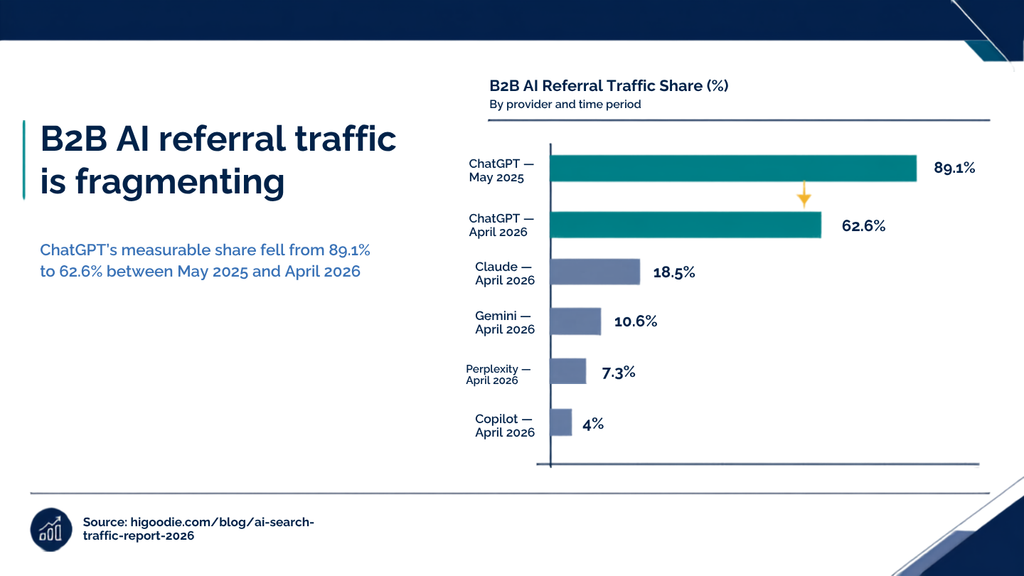
Why it matters: ChatGPT’s share of measurable B2B AI referrals fell from 89.1% to 62.6% between May–August 2025 and March–April 2026, according to AI Platform Goodie’s 2026 AI Search Traffic Report. Traffic fragmented across Claude (18.5%), Gemini (10.6%), Perplexity (7.3%), and Copilot (4%)
Good answer:
They name specific platforms and explain how their retrieval and citation approach changes across them. They can highlight the core major best practices that impact both search engines and “answer engines.”
Red flag:
“We optimize for Google AI Overviews.” That’s only one surface.
2. How do you define and measure entity optimization?
Why it matters: Entity optimization means structuring your brand’s information so a machine understands what you are, who you are, what you sell, where you operate, who vouches for you, and how it all connects to your ideal customer profile.
Good answer:
They focus on Schema markup, knowledge panels, entity disambiguation, and seed topic depth.
Red flag:
They describe traditional keyword research but swap in the word “entity.”
3. Which citation tracking tools and dashboards do you use?
Why is matters: You can’t manage what you don’t measure, and AI citations don’t show in Search Console. The reports simply show where your pages appear within AI features. Ask to see a sample dashboard.
Good answer:
They pull up a live tracking template showing indexing and citation frequency across AI surfaces on the call.
Red flag:
They offer generic GA4 rankings and sessions, pretending nothing changed.
4. Can you show me a before-and-after AI citation case study?
Why it matters: Brands cited in AI Overviews earn 35% more organic clicks and 91% more paid clicks than brands that aren’t cited.
Good answer:
A named client, citation baseline, what they changed, and the lift that followed.
Red flag:
Ranking screenshots offered as proof of GEO results.
5. How is your SEO strategy actually different from traditional SEO?
Why it matters: SEO transformed into a multi-surface visibility discipline, and GEO is one of the surfaces. If the answer is “GEO is SEO plus content marketing,” they’re describing 2019.
Good answer:
They can explain retrieval-augmented generation in plain English, and how passage-level optimization and structured authority signals change what you publish and how you structure it.
Red flag:
Buzzword density with no mechanism behind it.
6. What’s your approach to structured data and knowledge graphs?
Why it matters: AI engines lean on structured data to decide who is an authoritative source. This is the technical floor of the entire discipline. This is where small brands quietly beat big ones.
Good answer:
Schema implementation well beyond FAQ markup, entity disambiguation, knowledge graph relationships, and an audit process to keep it clean.
Red flag:
No mention of knowledge graphs at all.
7. How do you handle the organic traffic decline conversation?
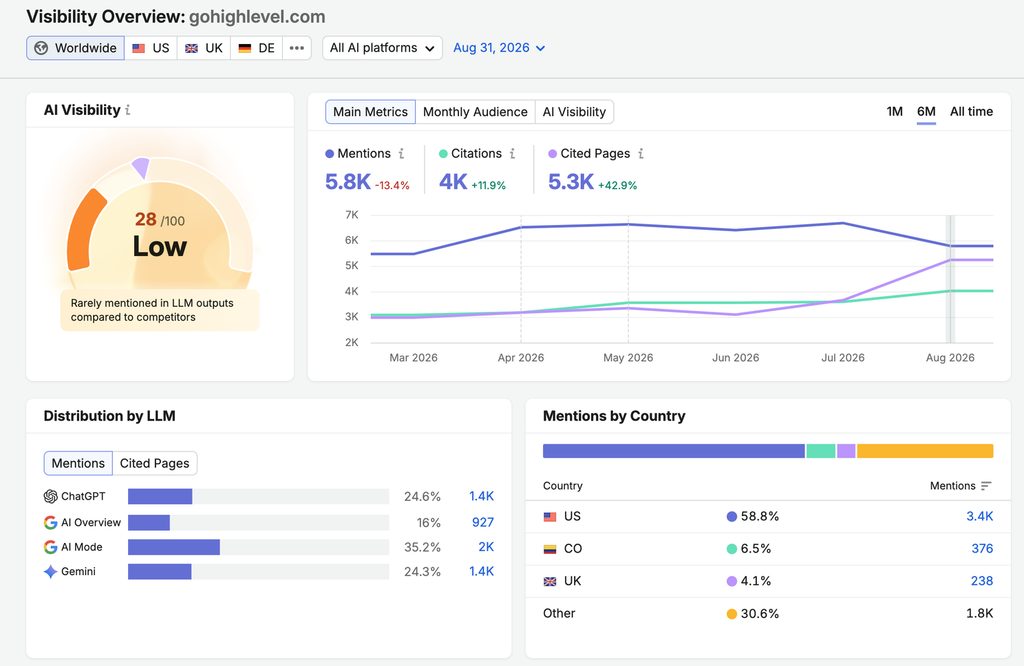
Why it matters: Traffic is down across the board, and it’s largely AI fragmentation; not a penalty, not a mystery core update. An agency that can’t admit this will spend your retainer chasing an imaginary problem.
Good answer:
They explain the shift, then reframe your KPIs around visibility, citation share, and qualified conversions.
Red flag:
Vague “algorithm volatility” talk without mention of AI Overviews and overall shift in search behavior.
8. How do you integrate paid and earned media with GEO?
Why it matters: Paid CTR on AI Overview queries dropped 68% YoY. Your media strategy cannot pretend that didn’t happen. Mentions and citations on third-party authoritative sources feed the signals AI engines use to decide who’s credible.
Good answer:
They treat GEO, paid, and PR as one visibility system.
Red flag:
GEO sold as a siloed deliverable, disconnected from everything else you’re spending on.
9. What content formats do you prioritize for AI retrieval?
Why it matters: AI engines extract passages, not entire pages. Concise, factual, well-attributed chunks with named entities and real statistics get pulled. Meandering 3,000-word posts written to hit a word count do not.
Good answer:
Passage-level architecture, direct-answer formatting, original data, clear entity naming.
Red flag:
Blog posts and landing pages aka the format list from a decade ago.
10. How often do you audit AI visibility across platforms?
Why it matters: According to the same Goodie 2026 AI Search Traffic Report ChatGPT lost 26.5 points of referral share in twelve months. A quarterly report is three months of blindness in a market moving that quickly.
Good answer:
Monthly or biweekly audits across ChatGPT, Gemini, Perplexity, Claude, and Copilot; plus a stated protocol for what happens when a new surface begins taking share.
Red flag:
One-time setup, quarterly reporting, no AI-specific audit process.
Why smaller brands are winning this one
AI engines reward authority signals and clarity, not domain size.
A 30-person company with clean structured data, unambiguous entity information, and genuinely useful passage-level content can get cited ahead of a competitor with a hundred times the backlinks and a knowledge graph full of contradictions.
Big brands are slow. Their sites are old, their markup is inconsistent, their teams are complacent and their agencies are still optimizing for a search results page that’s shrinking.
If you’re not sure where you currently stand, start with an SEO / AI visibility audit, find out which surfaces cite you today, which cite your competitors, and what’s missing from your entity footprint.
You can’t build a strategy on top of a guess.
Ask the ten questions. Take notes. Hire accordingly.
Drop a comment to share your .02 cents.
-David