
Key takeaways
- AI referral traffic to SMB sites rose 123% from September 2024 to February 2025. Semrush measured AI search visitors converting at 4.4x traditional organic.
- NerdWallet’s Q4 2024 filing showed revenue up 37% while monthly users fell 20%. The lost sessions sat on non-monetizing pages.
- You do not need position 1. Ahrefs found 26.2% of AI Overview citations ranked in positions 11–100, and 36.7% were outside the top 100.
- ChatGPT cannot retrieve a page Google has not indexed. Cited brands are the ones also named on Reddit, Quora, YouTube, and trade publications.
- Build one page per buyer prompt. Answer in the first 40–60 words, then place that same fact where each engine already pulls sources.
- Score it every two weeks: cited or not, which URL, and how many third-party pages mention the brand.
Referral traffic from generative AI to SMB sites rose 123% between September 2024 and February 2025, with ChatGPT the largest and most consistent referrer, according to a Search Engine Land report on 391 SMB websites.
Semrush found the average AI search visitor is worth 4.4x the average traditional organic visitor on conversion rate, in a study of digital marketing and SEO topics tracking non-Google sources such as ChatGPT. Semrush, AI search SEO traffic study.
NerdWallet’s own filing shows the split in one quarter. Q4 2024 revenue was $183.8 million, up 37% year over year, while average monthly unique users fell 20%, from 24 million to 19 million. The company said the traffic hit landed on non-monetizing “learn” topics and largely spared product marketplaces. NerdWallet Q4 and full-year 2024 results.
Organic drops with stable rankings are AI fragmentation, not a ranking collapse. ChatGPT, Perplexity, and Google AI Overviews are a separate channel. The moves below are the channel.
GEO sits on top of SEO
SEO is not dead but the job definitely expanded.
E-E-A-T, schema, and crawlability still feed the citation layer. Page one does not guarantee an answer inclusion. Cited pages are not only position 1. Ahrefs’ analysis of 4 million AI Overview URLs found 37.1% also ranked in the organic top 10 for the same query, 26.2% ranked in positions 11–100, and 36.7% did not appear in the top 100. CXL, citing the Ahrefs study. A page in positions 4–20 with a cleaner passage gets pulled while a stronger domain sits at number one and stays out of the source list.
Generative Engine Optimization is the work of earning that pull. Rankings stay on the dashboard. Citation share and branded-query growth join them.
Build the page an engine can lift
Do this before you chase a platform.
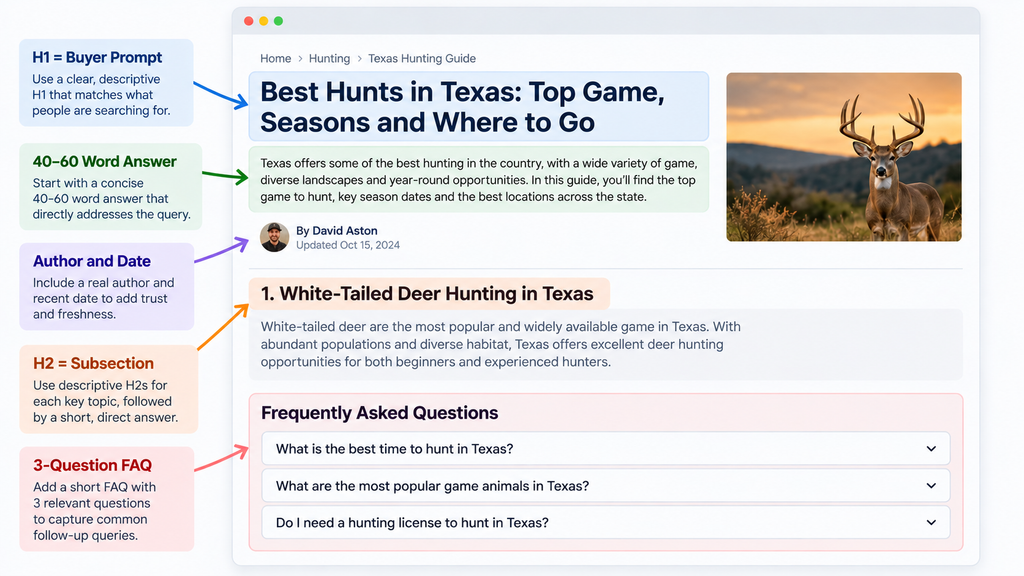
- Pick one buyer prompt. Write it the way a customer types it: “best [service] for [city]” or “how much does [job] cost in [market].”
- Make that prompt the H1. One page, one prompt.
- Answer in the first 40–60 words under the H1. Name the company, the market, the offer, and one number.
- Put a second direct answer in the first 40–60 words under every H2. Engines lift chunks. They do not summarize scroll depth.
- Add a named author, a date, and a source line next to every figure.
- Close with an FAQ of the three follow-up prompts. Each answer stays under 80 words.
That page is the asset. Everything else points engines at it.
ChatGPT: get indexed, then get corroborated
ChatGPT has held roughly 60–75% of AI chatbot and AI-referral share depending on the cut and the month. First Page Sage put ChatGPT at 61.3% of the AI search market by December 2025. TipRanks, citing First Page Sage. Later cuts still show it as the largest surface, which is why it is the first engine to brief.
Real-time answers do not come from training data alone. The Information reported that OpenAI retrieves Google Search data through SerpApi, a scraping firm, for topics where its own tools are thin. ZDNet write-up of that report. If Google has not indexed the page, that retrieval path cannot return it.
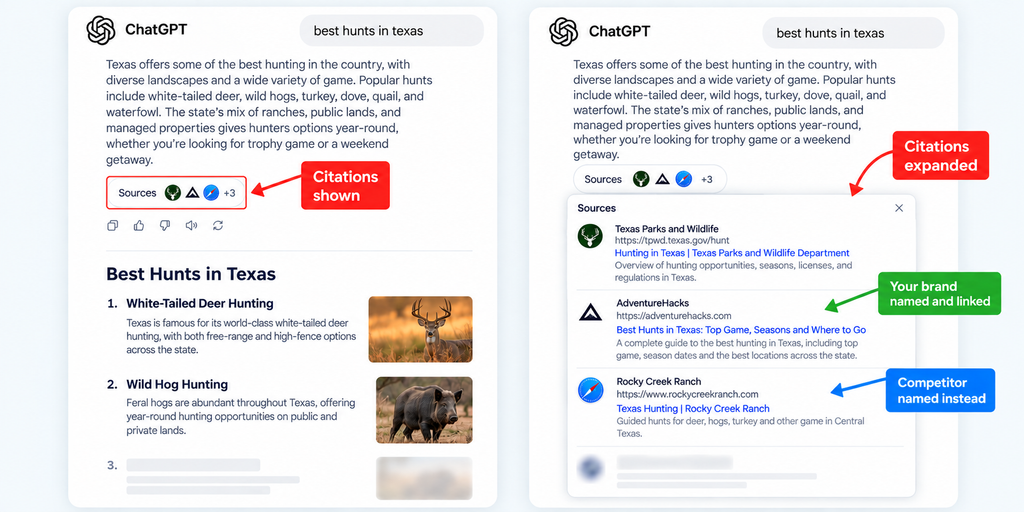
Indexed is the floor. Cited is the next step. ChatGPT favors brands mentioned across several credible third-party sources, not a single optimized URL. Reddit, Quora, YouTube, and industry publications are where those citations get pulled from, because those domains already sit in the indexes these systems retrieve.
Moves this week:
- Search the exact prompt in Google. If your page is absent, request indexing in Search Console.
- Confirm the entity string matches everywhere: site, Google Business Profile, YouTube channel, author bio. One spelling.
- Publish the prompt page with a quotable number. A model needs a fact it can attribute.
- Drop the same fact, with the company name, into one Reddit thread and one Quora answer that already rank for the prompt. Answer the question first. Link the page second.
- Add a YouTube description that repeats the entity and the number, then links the page.
- Pitch one trade publication or local outlet with the number as the story, not the product.
- Put an llms.txt file at the root listing the prompt pages. It does not replace indexing. It shortens the path.
Test it. Paste the buyer prompt into ChatGPT with search on. Log whether you are named, linked, or missing. Repeat the same prompt in two weeks.
Perplexity: win the source list
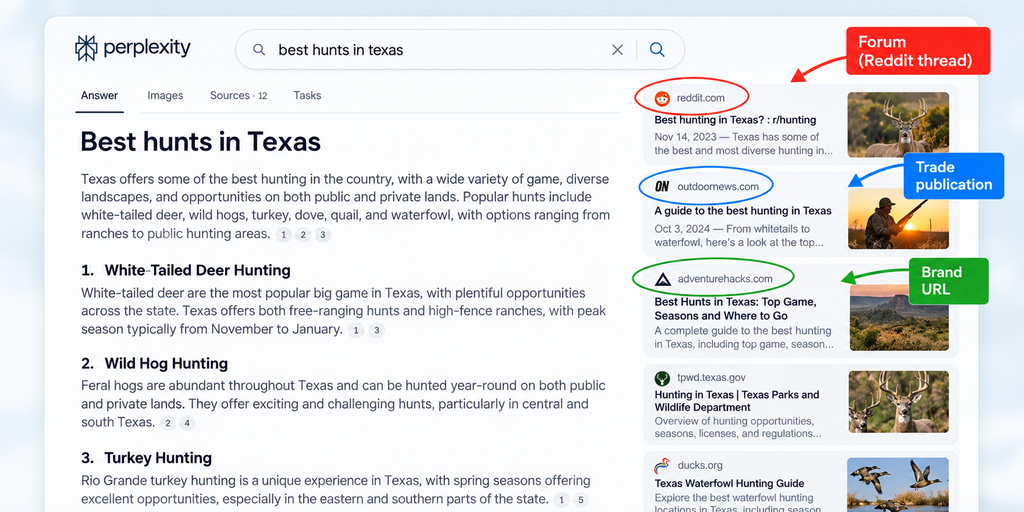
Perplexity ships sources with every answer. It weights recent, specific pages over homepages, and it will cite a forum thread or a niche publication when that page settles the query cleaner than a corporate blog.
Moves this week:
- Run the buyer prompt in Perplexity. Open every cited URL. Note the pattern: date, specificity, whether it is a forum, a publisher, or a brand page.
- Rewrite your prompt page so the first paragraph could replace one of those citations. Date it. Attach a figure. Name the entity in sentence one.
- Publish a fresher version of the off-site answer on the publication or subreddit Perplexity already cited for that prompt.
- Add an updated date and a short “what changed” line when the number moves. Perplexity prefers the newer specific page.
- Re-run the prompt. Screenshot the source list. That screenshot is the scorecard, not a ranking report.
A homepage slogan does not get lifted. A passage that settles the question does.
Google AI Overviews: win the passage
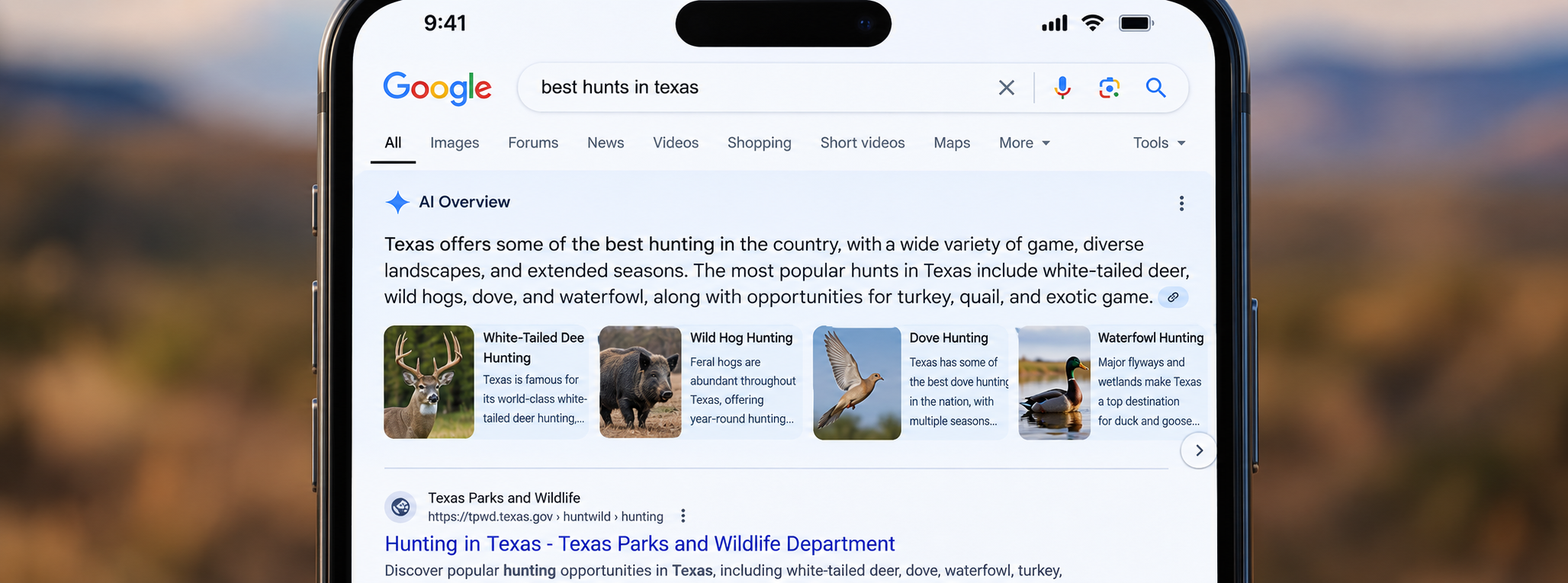
AI Overviews run a retrieval-augmented generation pipeline. Google retrieves passages from indexed pages, then writes the summary from the best-matching chunks. Google’s own description of AI Overviews.
Five operating pillars decide the winner: topical authority, E-E-A-T, content comprehensiveness, structured formatting, and technical crawlability. Since the December 2025 Core Update, E-E-A-T applies across content categories, not a narrow YMYL slice.
When an AI Overview and a featured snippet appear together, they occupy up to 76% of the mobile screen. Botify and DemandSphere measured that co-occurrence on 120,000 keywords: Overviews alone took about 48% of mobile screen space, and the pair pushed organic listings below the fold. Search Engine Journal on the Botify and DemandSphere study.
You do not need position 1. Passage relevance and trust signals drive the citation, which is why positions outside the top 3, including the 4–20 band, keep showing up in the source list.
Moves this week:
- Search the prompt on a phone. If an Overview is present, expand the sources. Record which positions they hold.
- Match the Overview’s sub-questions with H2s. Answer each in the first 40–60 words.
- Add FAQ schema and HowTo schema only where the visible copy matches. Markup that contradicts the page gets ignored.
- Add Organization or LocalBusiness schema sitewide, with the same name, address, and URL as the Google Business Profile.
- Cut the intro that delays the answer. The extractable block has to sit above the fold on mobile, because the Overview already took most of the screen.
- Build two supporting pages on adjacent prompts and link them with descriptive anchors. That is the topical cluster the pillar needs.
- Check crawl: page in the XML sitemap, submitted in Search Console, no accidental noindex, Core Web Vitals not failing.
Where the smaller brand actually wins
AI engines score topical depth and corroboration. Domain size and ad spend are weak signals next to a passage no enterprise team has written.
A 30-person firm with a case study and a proprietary number gets cited because the larger page is a category overview with no attributable fact. Third-party mentions on forums and trade sites are the footprint ChatGPT uses to decide you are real.
Ship one original number this month: jobs completed, cost range, time to result, cities served. Put it on the prompt page, in the Reddit answer, and in the publication pitch. That single fact is the asset a bigger brand cannot copy this quarter.
Technical floor, in order
- Organization or LocalBusiness schema, matching the visible NAP. Schema.org Organization and LocalBusiness.
- FAQ and HowTo schema on the pages that earn them. FAQ and HowTo.
- llms.txt at the root, listing the prompt pages.
- XML sitemap current, submitted to Google Search Console and Bing Webmaster Tools. Bing still feeds Copilot.
- Mobile load that does not fail Core Web Vitals.
- Quotable answer directly under every H2.
How you know it worked
Segment ChatGPT and Perplexity referrals in analytics and compare conversion rate to traditional organic. Semrush’s 4.4x gap is the benchmark. Your ratio is the weekly number.
Log three things every two weeks: cited or not on the buyer prompt, which URL got cited, and how many third-party pages mention the brand. Branded query growth is the lagging proxy. Track it next to citation share, not instead of clicks.
What to hand an agency
GEO is the prompt page, the schema, and the off-site mentions running in the same sprint. Most SMBs can publish the passage. Few can track citation share across ChatGPT, Perplexity, and Overviews while the corroboration footprint is being built.
A 30-minute visibility review names the gap: indexed but uncited, cited on one surface and missing on the other two, or losing the passage to a competitor outside position 1.
Early movers take the citation while larger competitors are still briefing a rank recovery.
Drop a comment with the prompt you want your business to own.
-David